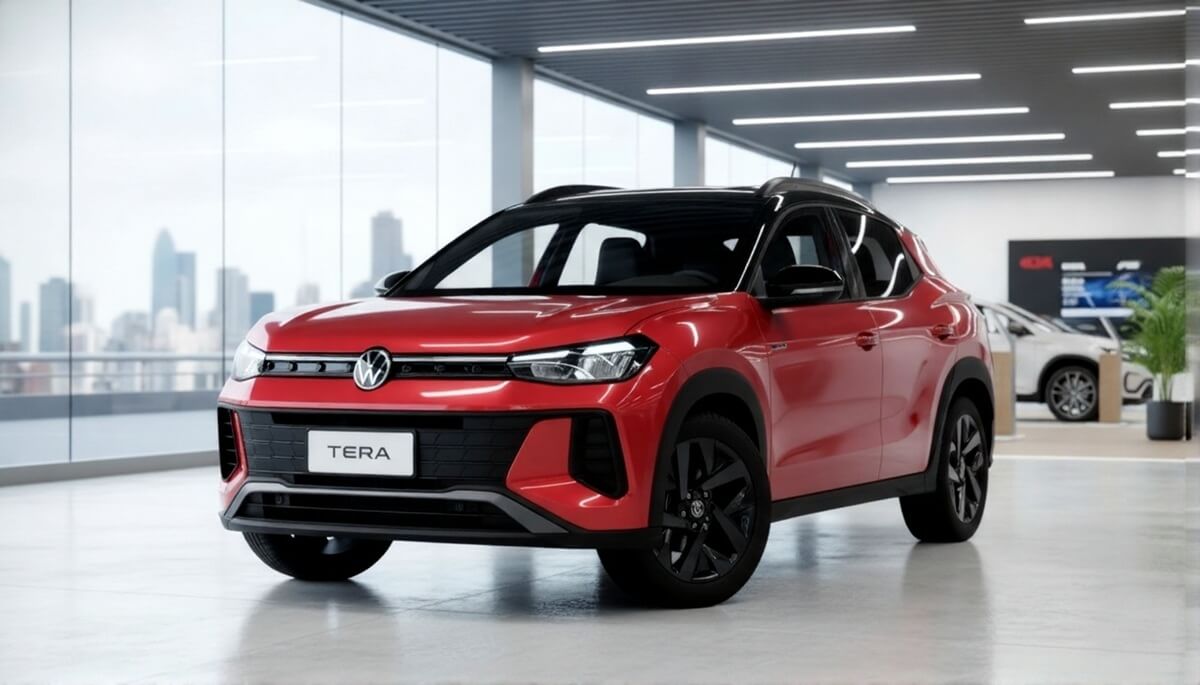
You’re stuck in bumper-to-bumper traffic on a Tuesday morning, and the car next to you catches your eye. It’s sleek, compact, and has that unmistakable Volkswagen badge. But wait, it’s not the Taigun or Tiguan you’re used to seeing. It’s something smaller, sharper, and undeniably more accessible. That’s the Volkswagen Tera coming soon to shake up the compact SUV segment.
If you’ve been eyeing the Tata Nexon or Hyundai Venue but craving that German engineering touch, the Tera might just be your answer. After spending weeks analyzing spy shots, Brazilian launch details, and competitor strategies, I’m here to break down everything you need to know about this upcoming game-changer. From expected pricing to performance specs, safety ratings to segment positioning, we’re diving deep into whether the Volkswagen Tera coming soon is worth the wait.
What is the Volkswagen Tera?
The Volkswagen Tera represents the German automaker’s ambitious entry into the ultra-competitive sub-4 meter SUV space. Think of it as the more affordable sibling to the Taigun, designed specifically for markets like India and Brazil, where compact dimensions and competitive pricing matter as much as build quality.
Unveiled in Brazil during the Rio Carnival in March 2025, the Tera isn’t just another badge-engineered model. It’s built on the localized MQB A0 IN platform, the same architecture that underpins the recently launched Skoda Kylaq. This platform sharing isn’t a compromise but a strategic move that keeps costs in check while maintaining Volkswagen’s legendary build standards.
What sets the Tera apart is its positioning. While the Kylaq targets premium compact SUV buyers, the Tera aims for a slightly broader audience, someone who wants German engineering without breaking the bank. It’s Volkswagen’s answer to a simple question: Can we build a sub-4 meter SUV that doesn’t feel like a compromise?


Also Read: Bullet 650 vs Continental GT 750: Which New Royal Enfield Wins the 650cc+ War?
Design and Dimensions of Volkswagen Tera
Exterior Styling
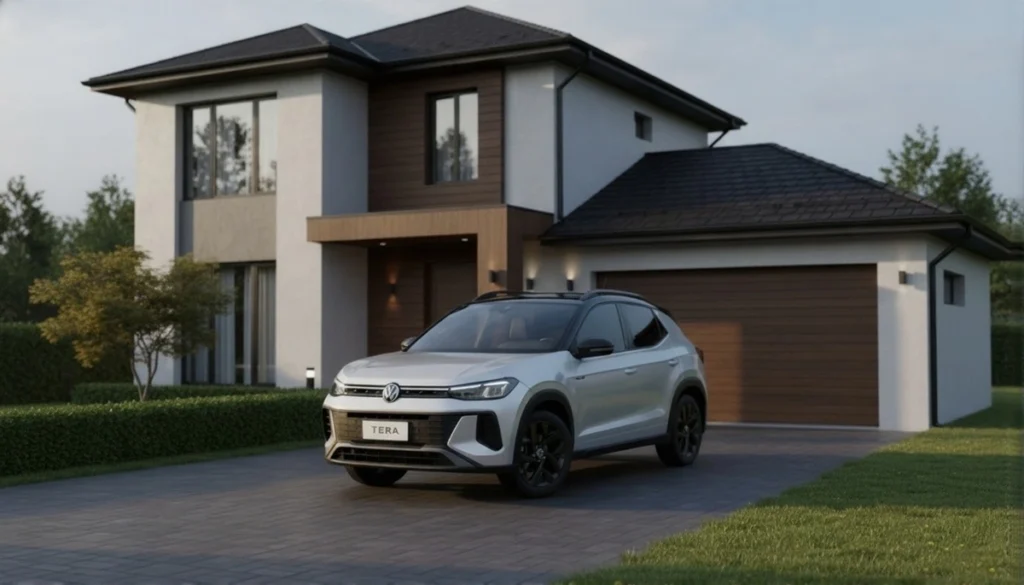
The Volkswagen Tera coming soon borrows heavily from its bigger sibling, the Tiguan, and that’s not a bad thing. The front fascia features the signature VW grille flanked by sleek LED headlamps with a distinctive two-piece DRL signature. The design team didn’t just shrink the Tiguan, they adapted its language to work on a compact canvas.
The side profile reveals black A-pillars and a floating roof design, a trend that’s become almost mandatory in modern SUVs but executed tastefully here. At the rear, slim LED taillights connected by black trim give the Tera a contemporary look without trying too hard. There’s even an Easter egg below the rear wiper showing silhouettes of the Beetle, Gol, and Tera, a neat touch for VW enthusiasts.
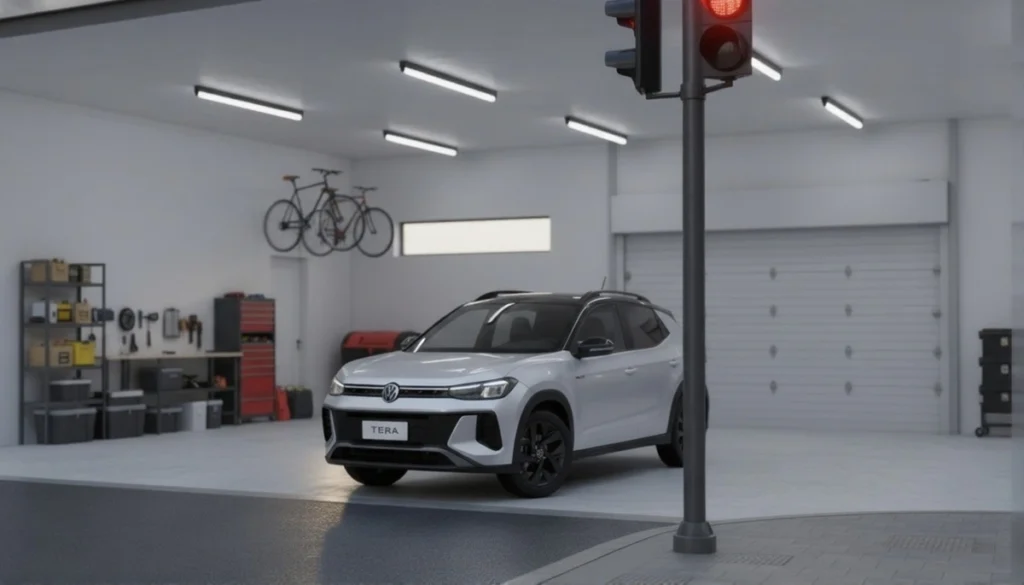
Higher variants come with 18-inch diamond-cut alloy wheels, while base models get 15-inch units. The ground clearance should be adequate for Indian road conditions, though official figures are yet to be confirmed.
Interior Space and Comfort
Step inside, and you’ll find a cabin that prioritizes function over flash. The dashboard layout is clean and ergonomic, dominated by an 8-inch touchscreen infotainment system and a digital instrument cluster. Climate control with rear AC vents ensures everyone stays comfortable, a crucial feature for Indian summers.
The wheelbase measures 2,566mm, identical to the Polo and Kylaq. This translates to decent rear legroom, though not class-leading. Boot space is expected to be around 400 liters, sufficient for weekend getaways but not as generous as the Nexon’s 382 liters or the XUV 3XO’s 364 liters.
Material quality should be a step above most rivals. Volkswagen’s attention to fit and finish has always been a strong point, and early Brazilian units suggest the Tera maintains this tradition. Soft-touch materials on key touchpoints and solid-feeling switchgear create an upmarket ambiance.
Platform and Build Quality
The MQB A0 IN platform is the Tera’s foundation, a modular architecture that’s proven itself across multiple VW Group products. This isn’t experimental technology but a mature platform optimized for emerging markets.
What does this mean for buyers? First, excellent crash safety potential. The platform has delivered 5-star Latin NCAP ratings in Brazilian tests, a promising sign for India’s Bharat NCAP evaluation. Second, refinement. The platform’s rigidity translates to better NVH insulation and a more planted feel at highway speeds.
The sub-4 meter length at 3,995mm qualifies the Tera for India’s favorable tax bracket, keeping prices competitive. This length constraint didn’t force major compromises; the Tera manages to look proportionate rather than stubby.


Engine and Performance of Upcoming Volkswagen Tera
Power and Torque
The Volkswagen Tera coming soon will feature VW’s tried-and-tested 1.0-liter TSI three-cylinder turbocharged petrol engine. This unit produces 114-116 bhp and 178 Nm of torque, numbers that position it squarely in the competitive sweet spot.
Compared to rivals, the Tera matches the Hyundai Venue and Kia Sonet’s turbo-petrol output while offering more torque than most. That 178 Nm figure, available from just 1,750 rpm, should make city driving effortless and highway overtakes confident.
The three-cylinder configuration might raise eyebrows among purists, but modern balancer shafts have largely eliminated the inherent vibrations that plagued earlier three-pots. VW has used this engine globally for years, so reliability shouldn’t be a concern.
Transmission Options
Buyers will choose between a 6-speed manual and a 6-speed torque converter automatic. The manual is reportedly slick and precise, typical VW fare. The automatic, unlike the jerky AMTs and occasionally laggy DCTs found in rivals, should offer smoother operation.
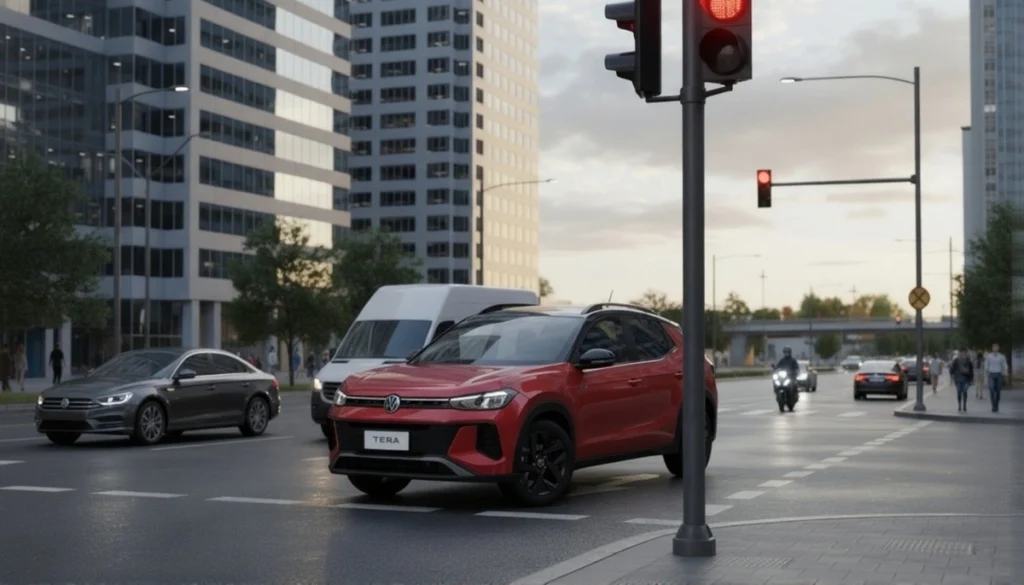
This transmission pairing gives the Tera an edge. While competitors like the Nexon offer DCT automatics that can be finicky in traffic, and the Sonet uses an iMT that takes getting used to, the Tera’s conventional torque converter is predictable and reliable.


Fuel Efficiency Expectations
Official ARAI figures aren’t out yet, but expect the Tera to deliver 17-19 km/l with the manual transmission and 16-18 km/l with the automatic. These numbers would be competitive with the Venue’s 17.5 km/l and better than the Nexon’s turbo-petrol variants.
Real-world efficiency will depend on driving patterns, but the TSI engine’s reputation for balancing performance and economy is well-established. City cycles should see 12-14 km/l, while highway cruising could push 18-20 km/l.
Technology and Features of Upcoming Volkswagen Tera
Infotainment System
The 8-inch touchscreen infotainment system will support wireless Apple CarPlay and Android Auto, essentials in 2025. The interface should be intuitive, VW’s recent systems have shed the complexity of older generations.
Expect connected car technology with remote vehicle monitoring, geo-fencing, and emergency assistance. These features have become table stakes in the segment, and VW won’t skip them.
Connectivity and Convenience
The digital instrument cluster provides customizable displays for trip data, navigation, and vehicle information. Climate control will be automatic on higher variants, with rear AC vents across the range.

Ventilated front seats, increasingly common in this segment, should feature on top variants. Wireless charging, a 12V socket, and multiple USB ports round out the convenience features. A single-pane sunroof is expected, though a panoramic unit seems unlikely given cost constraints.
Driver Assistance Features
While full ADAS isn’t confirmed, expect cruise control, rear parking sensors, and a reverse camera as standard equipment. Higher variants might add a 360-degree camera system and electronic stability control.
Hill-start assist and traction control will be standard, useful for Indian driving conditions. Tire pressure monitoring, now increasingly common, should also make the cut.
Safety Expectations
Safety is where the Volkswagen Tera coming soon could shine. The Brazilian version achieved a 5-star Latin NCAP rating in its most basic configuration, scoring well in adult and child occupant protection.
Six airbags will be standard across all variants, a significant advantage over rivals that offer this only on top trims. ABS with EBD, electronic stability program, and ISOFIX child seat mounts are confirmed.
The high-strength steel construction of the MQB A0 platform provides excellent crash protection. The crumple zones are engineered to absorb impact energy while maintaining cabin integrity, exactly what you want in an accident.
Bharat NCAP testing will be the real test for Indian buyers. Given the platform’s global safety record, a 4 or 5-star rating seems achievable.
Also Read: ADAS Levels 0 to 5: Which One Does Your Car Really Have?
Volkswagen Tera Specifications (Expected)
| Specification | Details |
|---|---|
| Engine | 1.0L TSI 3-cylinder turbo-petrol |
| Power | 114-116 bhp |
| Torque | 178 Nm |
| Transmission | 6-speed MT / 6-speed AT |
| Drivetrain | Front-wheel drive |
| Length | 3,995 mm |
| Width | 1,760 mm (expected) |
| Height | 1,650 mm (expected) |
| Wheelbase | 2,566 mm |
| Ground Clearance | 180-190 mm (expected) |
| Boot Space | 400 liters (expected) |
| Fuel Tank | 40-45 liters (expected) |
| Seating Capacity | 5 |
| Airbags | 6 (standard) |
| Infotainment | 8-inch touchscreen |
| Instrument Cluster | Digital |
| Expected Mileage (MT) | 17-19 km/l |
| Expected Mileage (AT) | 16-18 km/l |
Launch Timeline and Availability
The Volkswagen Tera made its global debut in Brazil in March 2025 and went on sale in May 2025. For India, the expected launch window is January to March 2026, giving VW time to localize production and build anticipation.
The Indian version will be manufactured at Volkswagen’s Chakan facility near Pune, the same plant that produces the Taigun and Virtus. This local production is crucial for competitive pricing and maintaining quality standards.
Bookings are expected to open 2-3 months before launch, likely with a token amount of Rs 25,000 to Rs 50,000. Initial deliveries should begin within a month of launch, assuming no supply chain disruptions.
Expected Pricing and Variants
Pricing is where the Volkswagen Tera coming soon needs to be strategic. Early estimates suggest a range of Rs 8 lakh to Rs 15 lakh (ex-showroom), positioning it competitively against the Nexon (Rs 7.99-15.79 lakh), Venue (Rs 7.90-15.69 lakh), and Kylaq (Rs 7.89 lakh onwards).
Expect four to five variants: a base model around Rs 8-8.5 lakh, a mid-spec variant at Rs 10-11 lakh, a feature-rich model at Rs 12-13 lakh, and a top-end variant at Rs 14-15 lakh. Automatic transmission will command a Rs 1-1.5 lakh premium.
The base variant will likely include essentials like dual airbags (though six airbags are standard), manual AC, and basic infotainment. The top variant will pack ventilated seats, automatic climate control, 18-inch wheels, and the full suite of safety features.
This pricing strategy would undercut the Kylaq slightly while offering comparable features, a smart move to attract buyers considering both brands.
Volkswagen Tera vs Competitors
| Feature | VW Tera | Skoda Kylaq | Tata Nexon | Hyundai Venue | Kia Sonet | Maruti Brezza |
|---|---|---|---|---|---|---|
| Starting Price | Rs 8 lakh* | Rs 7.89 lakh | Rs 7.99 lakh | Rs 7.90 lakh | Rs 7.99 lakh | Rs 8.34 lakh |
| Engine | 1.0L TSI | 1.0L TSI | 1.2L Turbo | 1.0L Turbo | 1.0L Turbo | 1.5L NA |
| Power | 114 bhp | 115 bhp | 120 bhp | 120 bhp | 120 bhp | 103 bhp |
| Torque | 178 Nm | 178 Nm | 170 Nm | 172 Nm | 172 Nm | 137 Nm |
| Transmission | 6MT/6AT | 6MT/6AT | 6MT/7DCT | 6MT/7DCT | 6iMT/7DCT | 5MT/6AT |
| Wheelbase | 2,566 mm | 2,566 mm | 2,498 mm | 2,500 mm | 2,500 mm | 2,500 mm |
| Boot Space | 400L* | 446L | 382L | 350L | 385L | 328L |
| Airbags | 6 (std) | 6 (std) | 6 (std) | 6 (std) | 6 (top) | 6 (top) |
| Sunroof | Yes* | Yes | Yes | Yes | Yes | Yes |
| Ventilated Seats | Yes* | Yes | Yes | Yes | Yes | Yes |
| 360° Camera | Expected | Limited Ed. | Yes | Yes | Yes | No |
| ADAS | No* | No | No | Yes (L2) | No | No |
| Safety Rating | 5★ Latin NCAP | Pending | 5★ GNCAP | Pending | Pending | 4★ GNCAP |
*Expected specifications
Who Should Wait for the Volkswagen Tera?
The Volkswagen Tera coming soon isn’t for everyone, but it’s perfect for specific buyer types.
Premium Brand Aspirants on a Budget: If you’ve always wanted a Volkswagen but found the Taigun too expensive, the Tera is your entry ticket. You get the badge, the build quality, and the driving dynamics at a more accessible price point.
Quality-Conscious Buyers: Those who prioritize build solidity and refinement over feature lists should consider the Tera. VW’s fit and finish typically exceeds rivals, and that matters for long-term ownership satisfaction.
Highway Cruisers: The TSI engine and stable platform make the Tera an excellent highway companion. If your commute involves 60-80 km daily highway runs, the Tera’s refinement at triple-digit speeds will be appreciated.
Safety-First Families: With six airbags standard and a 5-star crash rating potential, safety-conscious families will find the Tera reassuring. The solid build and comprehensive safety net justify consideration.
Not Ideal For: Diesel seekers, CNG fans, and those needing maximum features at minimum price should look elsewhere. The Nexon offers more powertrain variety, the Brezza offers better service network access, and the Venue packs more tech.
Also Read: Tesla Opened Its First Integrated Center In Gurugram
Future Predictions and Market Impact
The Volkswagen Tera coming soon could reshape the sub-4 meter SUV landscape in subtle but significant ways.
Market Disruption: VW’s entry brings serious German engineering to a segment dominated by Korean tech and Indian value propositions. This forces rivals to up their quality game, benefiting all buyers.
Platform Sharing Success: If the Tera succeeds, expect more aggressive platform sharing between Skoda and VW. The MQB A0 IN could underpin future compact cars, spreading development costs and enabling competitive pricing.
Premium Shift: The Tera and Kylaq together could elevate buyer expectations for build quality in this segment. What’s considered “premium” today might become standard tomorrow.
Sales Projections: Realistic first-year sales targets would be 3,000-4,000 units monthly, capturing 8-10 percent segment share. The Nexon currently sells 14,000-16,000 units monthly, so there’s room for multiple players.
Challenges Ahead: VW’s limited service network compared to Maruti or Hyundai remains a concern. Parts availability and service costs will determine long-term success more than launch hype.
Did You Know?
The Volkswagen Tera’s name means “Earth” in Portuguese, reflecting its Brazilian roots and connection to nature. Also, the MQB A0 platform is so versatile that it underpins vehicles ranging from the Polo hatchback to the T-Cross SUV across 20 countries.
FAQs: Volkswagen Tera Coming Soon
When will the Volkswagen Tera launch in India?
The Volkswagen Tera is expected to launch in India between January and March 2026. The SUV debuted in Brazil in March 2025, and VW needs time to localize production at its Chakan facility and adapt the vehicle for Indian market preferences. Bookings should open 2-3 months before the official launch.
What will be the Volkswagen Tera price in India?
The expected VW Tera price ranges from Rs 8 lakh to Rs 15 lakh (ex-showroom). The base variant should start around Rs 8-8.5 lakh, competing directly with the Tata Nexon, Hyundai Venue, and Skoda Kylaq. Top-spec automatic variants could reach Rs 14-15 lakh. Final pricing will depend on localization levels and feature packaging.
Is the Volkswagen Tera the same as the Skoda Kylaq?
The Volkswagen Tera and Skoda Kylaq share the same MQB A0 IN platform, engine, and transmission, but they’re distinct vehicles. The Tera has unique exterior and interior styling, different feature packaging, and may be priced slightly differently. Think of them as cousins rather than twins, similar to how the Taigun and Kushaq are related.
What engine will the Volkswagen Tera have?
The Volkswagen Tera will be powered by a 1.0-liter TSI three-cylinder turbocharged petrol engine producing 114-116 bhp and 178 Nm of torque. Transmission options include a 6-speed manual and a 6-speed torque converter automatic. This engine is known for its refinement and balance of performance and efficiency. No diesel or CNG options are expected at launch.
How safe is the Upcoming Volkswagen Tera?
The Volkswagen Tera achieved a 5-star rating in Latin NCAP crash tests in its most basic configuration, a strong safety indicator. The Indian version will come with six airbags as standard across all variants, along with ABS with EBD, electronic stability control, and ISOFIX child seat mounts. Bharat NCAP testing will provide India-specific safety scores, but the platform’s global safety record is excellent.
Should I wait for the Volkswagen Tera or buy a Tata Nexon now?
This depends on your priorities. Wait for the Tera if you value German build quality, refinement, and a smoother automatic transmission. The Tera also offers a longer wheelbase and potentially better highway manners. Choose the Nexon if you need a diesel or CNG option, want more transmission choices, or prefer immediate availability with an established service network. The Nexon also offers more features at comparable price points and has proven reliability in Indian conditions.
Final Verdict on Upcoming Volkswagen Tera
The Volkswagen Tera coming soon represents more than just another sub-4 meter SUV launch. It’s VW’s statement that German engineering can be accessible without being compromised.
Is it perfect? No. The lack of diesel and CNG options limits its appeal, the service network isn’t as extensive as rivals, and we’re yet to see how VW prices the feature-rich variants. But what the Tera offers is substance over flash, build quality that you feel every time you close the door, a driving experience that prioritizes refinement over raw specification numbers.
For buyers who’ve been waiting for a premium compact SUV that doesn’t feel like it’s cutting corners, the Tera deserves serious consideration. The combination of the proven TSI engine, the safety-focused platform, and VW’s attention to detail creates a compelling package.
The smart move? If you’re buying in the next 2-3 months, test drive the Kylaq, it shares the Tera’s mechanical DNA and will give you a taste of what to expect. If you can wait until early 2026, see both the Kylaq and Tera in person, then decide which variant and styling package suits you better.
One thing’s certain: the sub-4 meter segment just got more interesting. And that’s excellent news for Indian car buyers.
What’s your take on the Volkswagen Tera? Does German engineering at this price point excite you, or do you prefer the feature-loaded Korean alternatives? Drop your thoughts in the comments, let’s discuss what matters most in a compact SUV!