The Story Behind Pagani Zonda HP Barchetta
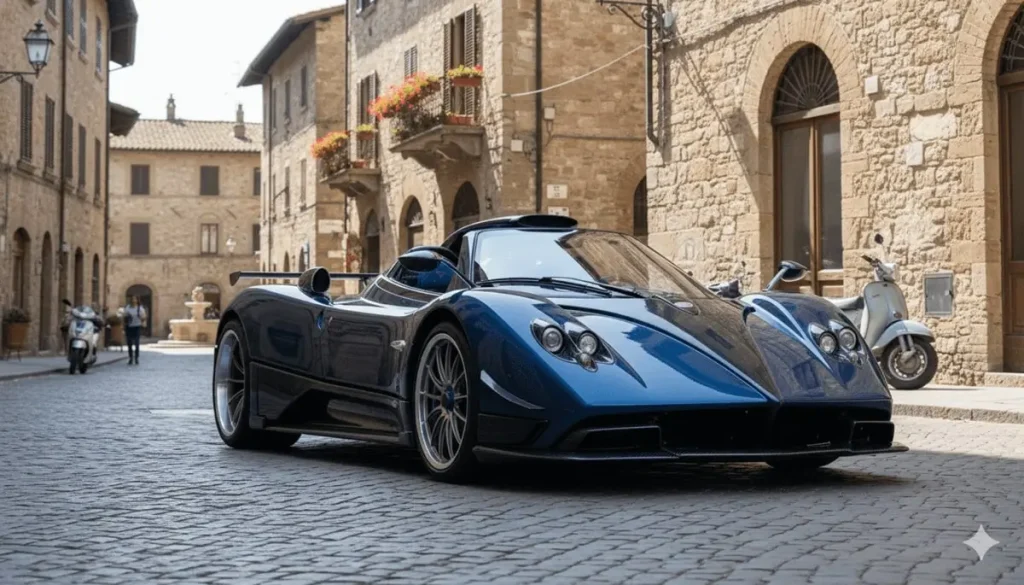
Imagine standing in front of a piece of automotive sculpture worth more than most people’s entire lifetimes. The Pagani Zonda HP Barchetta sits there, roofless and raw, with its carbon-titanium body shimmering under the sun. This isn’t just another hypercar, it’s the final love letter to an 18-year legacy.
When Horacio Pagani turned 60, he didn’t throw a party. Instead, he built himself the most exclusive, most expensive road-going Zonda ever created. Only three exist in the world. One belongs to him, the other two were sold before they even left the factory floor for $17.5 million each.
I’ve spent years covering hypercars, but the Pagani Zonda HP Barchetta is different. It’s not about lap times or top speed records. It’s about emotion, craftsmanship, and the dying art of naturally aspirated V12 engines. In this review, you’ll discover why this roofless masterpiece commands such an astronomical price, what makes it different from every other Zonda, and whether it truly deserves its crown as one of the most valuable cars ever built.
Horacio Pagani’s 60th Birthday Gift
The HP in Zonda HP Barchetta stands for Horacio Pagani himself. This wasn’t a commission from a billionaire client. This was pure passion. After nearly two decades of building Zondas in various forms, Horacio wanted to create something deeply personal, something that captured everything he loved about open-top driving and racing heritage.
The Barchetta took inspiration from 1960s Group C endurance racing cars, where drivers sat in open cockpits with minimal windshields. Horacio didn’t want a convertible with a folding roof mechanism. He wanted the purest driving experience possible, with nothing between the driver and the elements except a small aeroscreen.


Did You Know?
The word “Barchetta” means “little boat” in Italian, a term historically used for lightweight, open-top sports cars.
Design Philosophy: When Art Meets Engineering
The moment you see a Pagani Zonda HP Barchetta, you realize it doesn’t follow conventional automotive design rules. The bodywork looks like it was sculpted by wind itself. Every curve, every air intake, every exposed component serves both form and function.
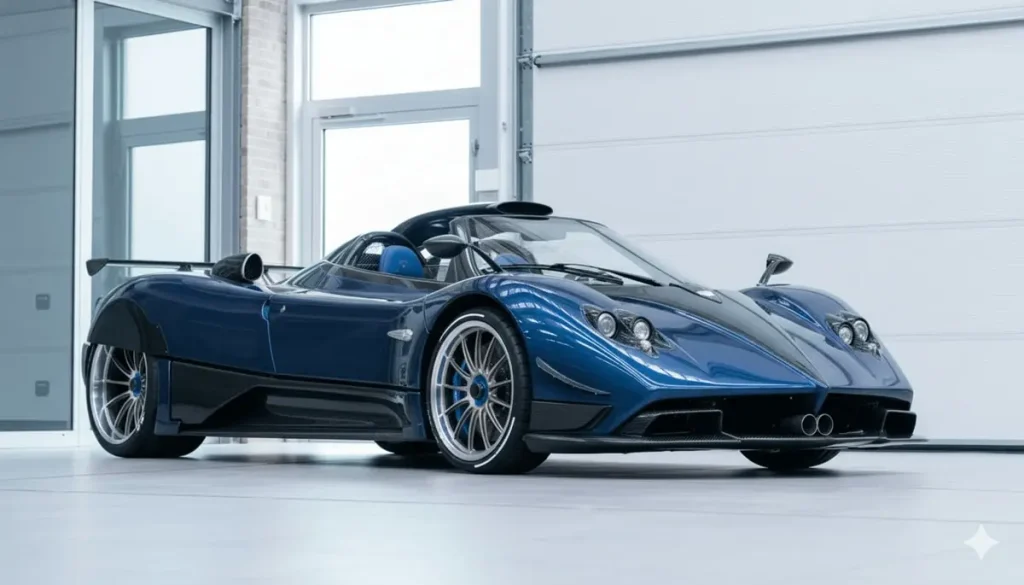
The most striking feature is obviously the missing roof. But Pagani didn’t just cut the top off a Zonda R. The entire chassis was re-engineered to maintain torsional rigidity without a fixed roof structure. The result is a car that weighs just 1,250 kg despite its complex carbon-titanium construction.
Group C Racing Inspiration
Look closely at the HP Barchetta and you’ll notice design elements borrowed directly from 1980s sports prototypes. The small wraparound windscreen offers minimal wind protection, forcing drivers to wear helmets at high speeds. The exposed rear suspension and the distinctive fairings over the rear wheels are pure racing aesthetics brought to the road.
The side-mounted exhausts exit just behind the driver’s head, creating a symphony of mechanical noise that would be illegal in most civilized countries. But when you’re building a $17.5 million car in a limited run of three, noise regulations become more of a suggestion than a requirement.
The attention to detail is obsessive. The mirror stalks are hand-carved from solid aluminum. The fuel cap is milled from a single block of aircraft-grade metal. Even the windscreen wipers, rarely seen on a car that will probably never see rain, are works of art.
The Heart of the Beast: 789 HP Naturally Aspirated V12
In an era where everything is turbocharged, hybrid, or electric, the Pagani Zonda HP Barchetta makes a defiant statement with its naturally aspirated 7.3-liter Mercedes-AMG V12. This is the same basic engine architecture that powered the original Zonda C12 back in 1999, but heavily modified by AMG’s performance division.
The 7.3L Mercedes-AMG M120 V12
This isn’t your typical luxury car V12. AMG took the already legendary M120 engine and rebuilt it from the inside out. Forged internals, titanium connecting rods, individual throttle bodies for each cylinder, and a dry-sump lubrication system allow this engine to rev to 7,500 rpm while producing 789 horsepower and 575 lb-ft of torque.
The sound is something you feel in your chest before you hear it with your ears. Unlike modern turbocharged engines that sound muffled and synthetic, the HP Barchetta’s V12 screams with mechanical fury. Every gear change produces a crackling exhaust note that echoes off building blocks away.
Power goes to the rear wheels through a six-speed sequential manual transmission. Yes, manual. No dual-clutch automatic, no paddle shifters with fifteen different driving modes. Just a manual sequential gearbox that requires skill and commitment. Horacio Pagani believes driving should be an active experience, not a video game.
Performance That Defies Logic
With 789 horsepower and just 1,250 kg to move, the power-to-weight ratio is absolutely savage. Pagani claims 0-60 mph happens in under 3.4 seconds, but in a car with this much drama and this little electronic assistance, straight-line acceleration numbers feel almost irrelevant.

The top speed is electronically limited to 221 mph, not because the car can’t go faster, but because at those speeds without a roof, the aerodynamic forces become genuinely dangerous. Even at 150 mph, the wind buffeting is intense enough that you need a full-face helmet unless you enjoy having your eyeballs dried out.
Carbo-Titanium Monocoque Construction
The entire chassis is built using Pagani’s proprietary Carbo-Titanium weave, a material that combines carbon fiber with titanium threads for incredible strength and minimal weight. This material is typically reserved for Formula 1 cars and aerospace applications. It’s also absurdly expensive to manufacture, which partially explains the $17.5 million price tag.
The suspension uses forged aluminum components with pushrod-actuated dampers, again borrowed from racing technology. The brakes are carbon-ceramic discs gripped by six-piston calipers at all four corners. In testing, the HP Barchetta can stop from 60 mph in less than 100 feet, assuming you don’t lose your helmet in the process.
Also Read: Hyundai CRATER Concept: The Ultimate Off-Road SUV Unveiled at AutoMobility LA 2025
The Barchetta Experience: What It’s Like Behind the Wheel
Climbing into the Pagani Zonda HP Barchetta requires a certain level of flexibility. The door sills are wide and tall, and once inside, you’re sitting in what can only be described as a carbon fiber cocoon. Everything within reach is covered in either leather, aluminum, or exposed carbon fiber.
Open-Top Driving Dynamics
Without a roof, the sensory overload is immediate. The V12 engine sits directly behind your head, separated by nothing more than a sheet of carbon fiber. At idle, it rumbles with a deep mechanical growl. Touch the throttle and the entire car comes alive with vibration and noise.
Driving the HP Barchetta at normal speeds feels like piloting a piece of functional art. The steering is heavy and communicative, every input translates directly to the front wheels without any electronic filtering. The clutch is heavy and requires muscle, a reminder that this car demands respect.
Push harder and the character changes completely. The V12 screams as it climbs toward redline, the sequential transmission cracks through gears with mechanical precision, and suddenly you’re traveling at speeds that feel absolutely terrifying without a windscreen.
One owner described it perfectly: “It’s like being strapped to a missile, except the missile is also a work of art and costs more than a private jet.”
Did You Know? Each Pagani Zonda HP Barchetta takes over 5,000 hours of hand labor to complete, with craftsmen spending weeks on details most owners will never even notice.
Technology and Features
Calling the Pagani Zonda HP Barchetta “low tech” would be misleading. Yes, it lacks touchscreens, hybrid systems, and self-driving capabilities. But the engineering behind every component represents the absolute cutting edge of analog automotive technology.
The instrument cluster is a beautifully machined aluminum piece with analog gauges. No digital screens, no customizable displays, just perfectly weighted needles that sweep across classic white faces. The center console houses the gated shifter and a series of toggle switches that control essential functions.
There’s no infotainment system, no navigation, no smartphone integration. Pagani’s philosophy is simple: if you’re wealthy enough to afford this car, you already have people who can tell you where to go.
The only concession to modernity is a basic traction control system that can be completely disabled with a single switch. Most owners apparently leave it off permanently, preferring the raw, unfiltered experience.
Pagani Zonda HP Barchetta Specifications
| Specification | Details |
|---|---|
| Engine | 7.3L Naturally Aspirated V12 (Mercedes-AMG M120) |
| Power | 789 HP @ 6,900 RPM |
| Torque | 575 lb-ft @ 5,500 RPM |
| Transmission | 6-Speed Sequential Manual |
| Drivetrain | Rear-Wheel Drive |
| 0-60 mph | 3.4 seconds (claimed) |
| Top Speed | 221 mph (electronically limited) |
| Weight | 1,250 kg (2,756 lbs) |
| Power-to-Weight | 631 HP/ton |
| Chassis | Carbo-Titanium Monocoque |
| Brakes | Carbon-Ceramic Discs (Front & Rear) |
| Production | 3 units |
| Price | $17.5 Million USD |
Competitor Comparison: How It Stacks Against the Elite
When you’re shopping in the $17.5 million hypercar segment, your options are extremely limited. Let’s see how the Pagani Zonda HP Barchetta compares to other ultra-exclusive automotive masterpieces.
| Model | Pagani Zonda HP Barchetta | Bugatti La Voiture Noire | Rolls-Royce Sweptail |
|---|---|---|---|
| Price | $17.5 Million | $18.7 Million | $13 Million |
| Production | 3 Units | 1 Unit | 1 Unit |
| Engine | 7.3L NA V12 | 8.0L Quad-Turbo W16 | 6.75L Twin-Turbo V12 |
| Power | 789 HP | 1,479 HP | 453 HP |
| 0-60 mph | 3.4 sec | 2.4 sec | 5.6 sec |
| Top Speed | 221 mph | 261 mph | 150 mph |
| Weight | 1,250 kg | 1,978 kg | 2,500 kg+ |
| Philosophy | Raw driving purity | Ultimate speed luxury | Coachbuilt elegance |
vs Bugatti La Voiture Noire
The Bugatti is faster, more powerful, and technically more advanced. But it’s also heavier, more civilized, and designed for effortless grand touring rather than a visceral driving experience. The Bugatti coddles you with luxury, the Pagani challenges you to be a better driver.
vs Rolls-Royce Sweptail
The Sweptail represents the opposite philosophy. It’s about ultimate comfort, bespoke craftsmanship, and making a statement at the yacht club. The Pagani is about performance, emotion, and celebrating the art of driving. If the Sweptail is a tailored suit, the HP Barchetta is racing leathers.
The $17.5 Million Question: Is It Worth It?
Justifying $17.5 million for any car is essentially impossible using rational economics. For that price, you could buy a fleet of supercars, a private jet, or a small island. But the Pagani Zonda HP Barchetta isn’t about rational economics.
Also Read: Kia Sorento India Spy Shots: 5 Things We Know About the Upcoming Launch
Investment Value and Collector Appeal
From a pure investment standpoint, the HP Barchetta is likely one of the safest automotive investments you can make. With only three ever produced, and with Pagani having moved on to the Huayra platform, these represent the absolute final chapter of the Zonda story.
Early Zonda models that originally sold for $300,000 to $500,000 are now trading hands for over $5 million. Special editions like the Zonda Revolucion have appreciated dramatically. The HP Barchetta, being the rarest and most expensive Zonda variant, will almost certainly increase in value over time.

Collectors view it as automotive art, a piece that represents the end of an era when small independent manufacturers could still build completely analog supercars without hybrid systems or electronic nannies. In 20 years, when everything is electric and autonomous, the HP Barchetta will be remembered as one of the last true driver’s cars.
Did You Know? One of the three HP Barchettas was involved in a crash in Croatia in 2022, requiring extensive repairs at the Pagani factory, making the remaining two examples even more valuable.
Pros and Cons
Pros:
- Unmatched Exclusivity: Only 3 exist in the entire world
- Naturally Aspirated V12 Perfection: 789 HP of screaming mechanical symphony
- Carbo-Titanium Construction: F1-level materials and engineering
- Investment Potential: Extremely likely to appreciate significantly over time
- Pure Driving Experience: No electronic filters, just raw mechanical feedback
Cons:
- Astronomical Price: $17.5 million puts it beyond 99.9999% of humanity
- Zero Practicality: No roof, minimal storage, impossible to use daily
- Maintenance Complexity: Servicing requires factory support and costs a fortune
- No Weather Protection: Rain, sun, wind, you’re exposed to everything
- Availability: Even if you have the money, you can’t buy one, they’re all sold
Final Verdict: The Ultimate Collector’s Dream
The Pagani Zonda HP Barchetta represents something increasingly rare in the automotive world: absolute commitment to a vision without compromise. It’s not practical, it’s not comfortable, and it’s certainly not affordable. But it’s also one of the purest expressions of automotive passion ever created.
If you’re an enthusiast dreaming about hypercar ownership, the HP Barchetta exists in a different universe. But if you’re a collector with virtually unlimited resources who values exclusivity, craftsmanship, and driving purity above all else, this is possibly the ultimate acquisition.
For the ultra-wealthy buyer, I’d say this: if you already own multiple Paganis, have a climate-controlled garage, and want the absolute rarest piece of modern automotive history, the HP Barchetta is worth every penny of that $17.5 million. It will never depreciate, it will always turn heads, and 50 years from now, automotive historians will study it as a masterpiece.
For everyone else, we can admire it from afar, watch videos of it screaming through tunnels, and appreciate that in a world increasingly dominated by electric crossovers, someone still has the courage to build cars like this.
So here’s my question for you: If you had $17.5 million to spend on a single car, would you choose the raw, visceral Pagani Zonda HP Barchetta, or would you go for something more practical like a Bugatti or a collection of classic cars? Drop your thoughts in the comments below.
Frequently Asked Questions
How many Pagani Zonda HP Barchettas were made?
Only three Pagani Zonda HP Barchettas were ever produced. One belongs to Horacio Pagani himself, and the other two were sold to private collectors for $17.5 million each before production even began.
What does HP stand for in Pagani Zonda HP Barchetta?
HP stands for Horacio Pagani, the founder of Pagani Automobili. He created this special Zonda variant as a personal project to celebrate his 60th birthday.
Can you drive the Pagani Zonda HP Barchetta in the rain?
Technically, yes, but it’s not recommended. With no roof and only a small windscreen, driving in the rain would be extremely uncomfortable and potentially dangerous. Most owners probably never drive their HP Barchettas in anything less than perfect weather.
What engine does the Pagani Zonda HP Barchetta use?
It uses a 7.3-liter naturally aspirated V12 engine developed by Mercedes-AMG, specifically the M120 engine modified to produce 789 horsepower and 575 lb-ft of torque.
Is the Pagani Zonda HP Barchetta street legal?
Yes, despite its extreme design and lack of a roof, the HP Barchetta is street legal in most countries. However, it doesn’t meet certain safety and emissions regulations in places like the United States, making it essentially a European and Middle Eastern exclusive.
Will the Pagani Zonda HP Barchetta increase in value?
Almost certainly. With only three produced, representing the final Zonda variant, and coming from a manufacturer with a proven track record of strong value appreciation, the HP Barchetta is considered one of the safest hypercar investments available, though at $17.5 million, only a very select few can make that investment.