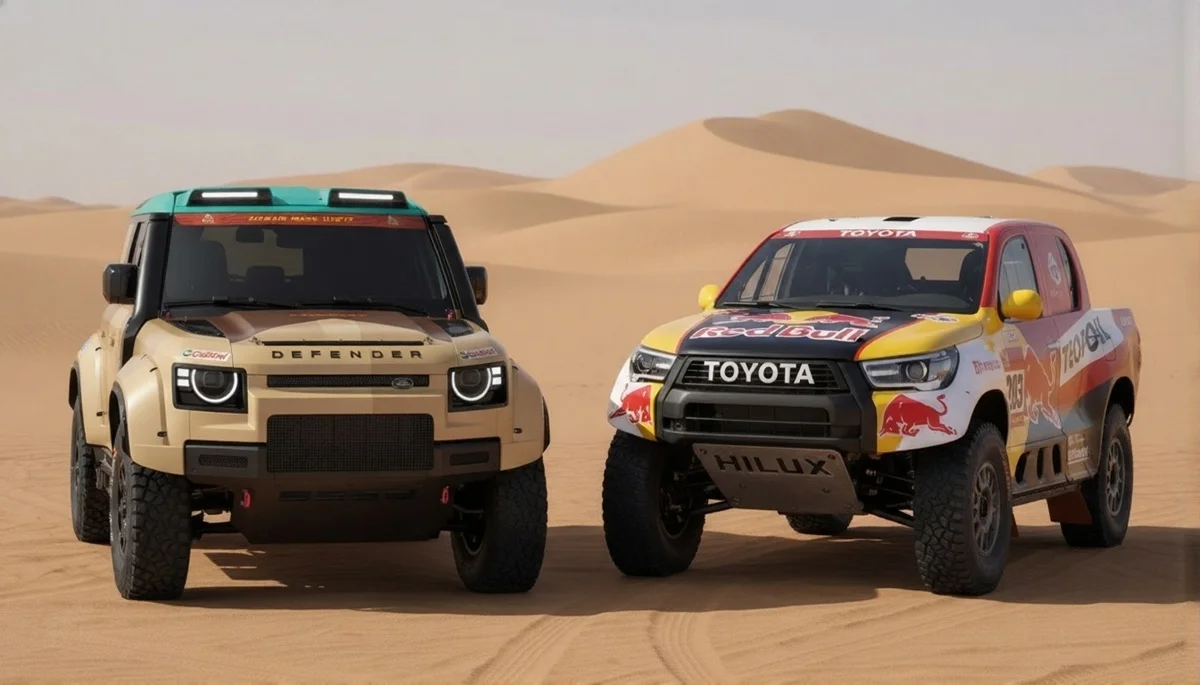
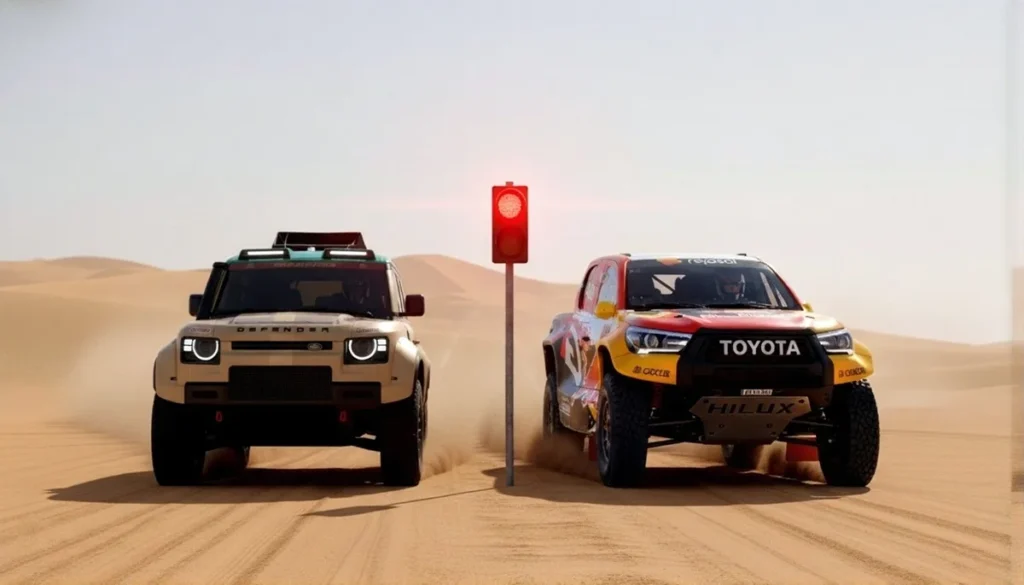
Imagine this. In January 2026, somewhere deep in Saudi Arabia’s Empty Quarter. The temperature hits 45 degrees Celsius, sand dunes stretch endlessly, and two titans are about to clash in the world’s toughest motorsport event. On one side, Toyota, the unstoppable Dakar juggernaut with four consecutive manufacturers’ titles. On the other hand, Land Rover’s Defender D7X-R, the British bulldog making its debut in the Stock category with legendary rally driver Stéphane Peterhansel behind the wheel.
I’ve been following the Dakar Rally for over a decade, and I can tell you this: no challenger has arrived with this much engineering pedigree and pure audacity since Audi’s diesel revolution in the 2000s. The Defender D7X-R dethrone Toyota at Dakar 2026 question isn’t just about racing. It’s about legacy, innovation, and whether British engineering can crack Toyota’s seemingly unbreakable code. Let’s dive deep into this epic showdown.
The Stage is Set: Dakar 2026 and the Stock Category Revolution
The 2026 Dakar Rally, scheduled from January 3-17 in Saudi Arabia, represents a pivotal moment in off-road motorsport. The Stock category, where the Defender D7X-R will compete, demands vehicles maintain closer ties to their production counterparts compared to the prototype-heavy Ultimate category, where Toyota has dominated.
This isn’t just another race entry. Land Rover is returning to Dakar after decades away, and they’re doing it with a vehicle that blends 75 years of off-road heritage with cutting-edge rally technology. The timing couldn’t be more strategic. With new FIA regulations leveling the playing field and Toyota potentially vulnerable after years of dominance, Land Rover sees an opening.
The Stock category rules require vehicles to retain production chassis, body structure, and major mechanical components. This plays directly into the Defender’s strengths, a platform born from extreme terrain testing across every continent. While Toyota has mastered the prototype game, can they maintain supremacy when the rules favor production-based engineering?



Land Rover Defender D7X-R: The British Challenger
Design and Build Philosophy
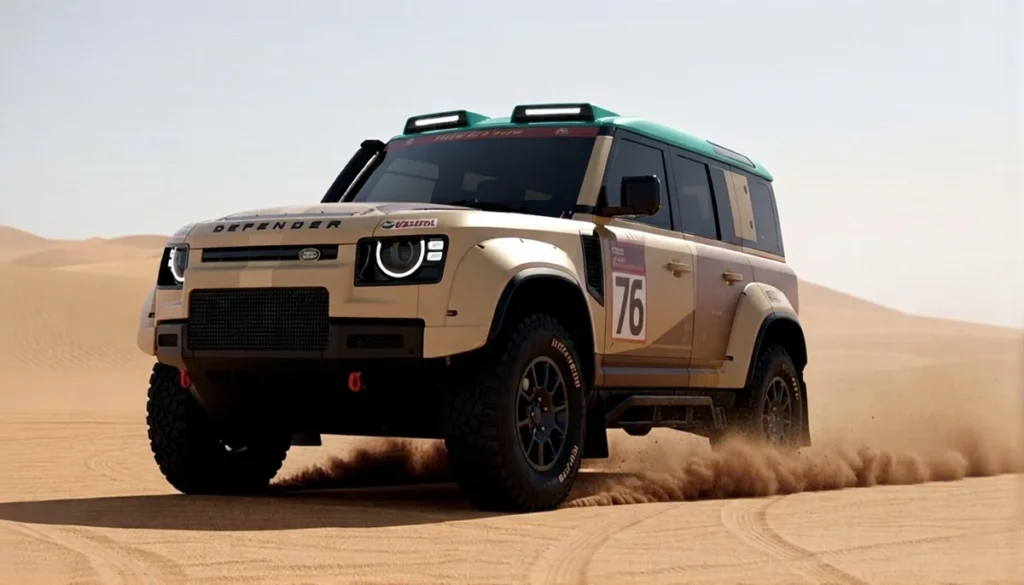
The Defender D7X-R isn’t your typical Defender with a roll cage welded in. Land Rover’s Special Vehicle Operations spent three years developing this beast, combining the D7X’s already proven platform with rally-specific enhancements that would make any engineer’s heart race.
The monocoque body architecture retains the Defender’s legendary rigidity while shedding unnecessary weight. Carbon fiber composite panels replace steel where regulations allow, and the suspension geometry has been completely reimagined for high-speed desert running. The wheelbase sits at 101.9 inches, providing stability at speed while maintaining agility through technical sections.
What really catches my eye is the attention to cooling. Saudi Arabia’s summer temperatures can destroy unprepared vehicles, and Land Rover engineers have installed massive heat exchangers, upgraded radiators, and strategic air ducting that would make a Formula 1 team jealous. The 145-gallon fuel tank means fewer stops, a critical advantage in marathon stages.
Engine and Performance Capabilities
Under that reinforced hood sits a 4.4-liter twin-turbocharged V8 engine, the same basic unit powering Range Rover’s performance variants but extensively modified for rally duty. While FIA regulations restrict peak power output in the Stock category, the Defender D7X-R still produces substantial horsepower paired with massive low-end torque, perfect for sand and rocks.
The eight-speed automatic transmission has been recalibrated with rally-specific gear ratios and reinforced internals to handle the punishment of 5,000 kilometers across brutal terrain. Permanent four-wheel drive with electronically controlled differentials ensures power reaches the ground efficiently, whether climbing dunes or sliding through rocky wadis.
Here’s where it gets interesting. Land Rover developed what they call Flight Mode, a suspension setting that pre-loads the dampers before jumps and adjusts rebound rates mid-air. I’ve seen test footage of the D7X-R launching off dunes with stability that seems physics-defying. This kind of innovation could be the difference between winning and breaking down in the Saudi desert.
Technology and Innovation
The cockpit resembles a fighter jet more than a car interior. Digital displays provide real-time telemetry, navigation data streams directly from rally headquarters, and the Terrain Response 2 system has been enhanced with Dakar-specific modes developed through thousands of testing kilometers.
Carbon-ceramic brakes provide fade-resistant stopping power, critical when descending rocky mountain passes at speed. The suspension features remote reservoir dampers with 280mm of wheel travel, more than most trophy trucks. Ground clearance sits at a commanding 11.5 inches, and approach and departure angles have been optimized to clear obstacles that would stop lesser vehicles.
Did You Know? The Defender D7X-R’s navigation system can store up to 15 different route variations per stage, allowing drivers and co-drivers to adapt strategy in real-time based on changing conditions or mechanical issues.
Toyota’s Dakar Dynasty: The Reigning Champion
Toyota’s Dominance by the Numbers
Let’s be brutally honest here. Toyota doesn’t just win at Dakar; they dominate. Four consecutive FIA World Rally-Raid Championship manufacturers’ titles, three Dakar Rally overall victories in the last five years, and a driver lineup that reads like a motorsport hall of fame roster.


Their Hilux-based rally vehicles have proven nearly unbeatable in the Ultimate category competition. The secret? Relentless development, deep motorsport experience, and a team culture that treats every stage like a championship decider. Toyota Gazoo Racing South Africa has refined their Dakar formula to near perfection, combining bullet-proof reliability with competitive speed.
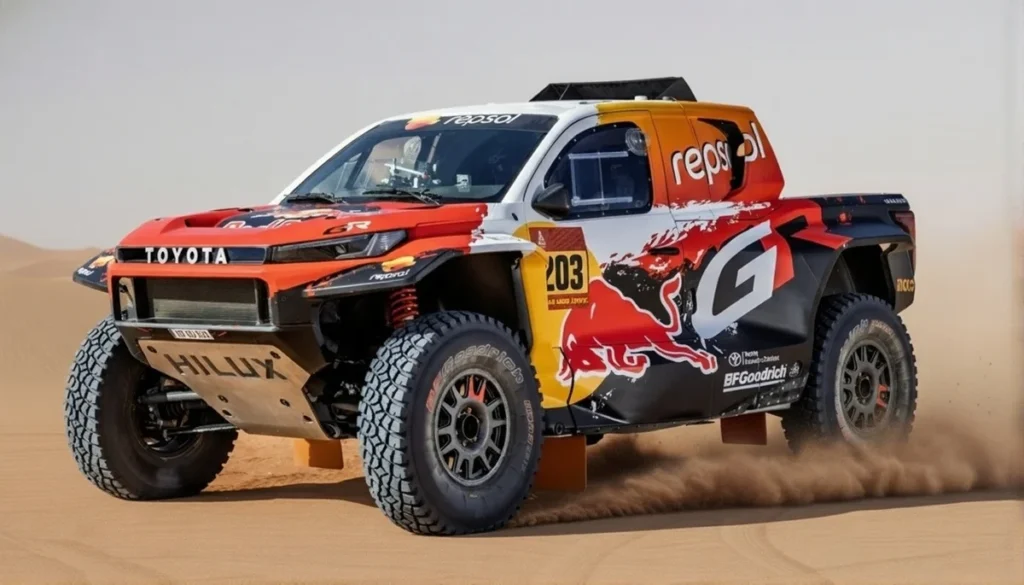
What makes Toyota particularly dangerous is their experience advantage. They’ve competed in every Dakar since 2012, accumulating institutional knowledge about Saudi Arabia’s terrain, weather patterns, and strategic stage planning that money simply cannot buy overnight. When you’ve won as much as Toyota has, you learn how to manage races, not just win stages.
The New DKR GR Hilux for 2026
Toyota isn’t resting on their laurels. For 2026, they’re bringing an updated DKR GR Hilux that addresses weaknesses exposed in recent rallies. The chassis has been reinforced in critical stress areas, the transmission received upgraded internals, and the suspension geometry was fine-tuned based on 2025 race data.
Power comes from a naturally aspirated V8 engine producing significant horsepower within FIA’s regulations. Toyota’s philosophy favors naturally aspirated reliability over turbocharged complexity, a choice validated by their stellar finish rates. The four-wheel-drive system features Toyota’s proven front and rear differential setup with center differential lock, simple but devastatingly effective.
The driver lineup reads like Dakar royalty. Henk Lategan, Guy Botterill, Lucas Moraes, and Saood Variawa bring diverse skill sets and championship-winning experience. This depth means if one crew faces mechanical issues, others can still secure manufacturer points, a luxury Land Rover doesn’t have in their debut year.


Why Toyota Keeps Winning
Reliability. That’s the unglamorous answer nobody wants to hear, but everyone knows is true. Dakar doesn’t crown the fastest vehicle; it crowns the one that finishes. Toyota’s finish rate hovers near 80 percent, an astronomical number in a race where mechanical failures end half the field’s dreams.
Their race strategy is equally impressive. Toyota teams coordinate pace, share mechanical insights, and sacrifice individual stage wins for overall championship points. It’s team racing executed at the highest level, and it drives competitors crazy because there’s no single weakness to exploit.
The other factor? Experience under pressure. Toyota crews have navigated every disaster scenario imaginable, from navigation errors to catastrophic mechanical failures, and they know how to recover. That psychological advantage, knowing you’ve survived worse, can’t be quantified, but absolutely matters when everything goes wrong at 180 km/h in a sandstorm.
Head-to-Head: Defender D7X-R vs Toyota GR Hilux
Specification Comparison Table
| Specification | Land Rover Defender D7X-R | Toyota DKR GR Hilux |
|---|---|---|
| Engine | 4.4L Twin-Turbo V8 | Naturally Aspirated V8 |
| Transmission | 8-Speed Automatic | 6-Speed Sequential |
| Drivetrain | Permanent AWD with electronic diffs | Part-time 4WD with locking diffs |
| Wheelbase | 101.9 inches | 122 inches |
| Suspension Travel | 280mm | 270mm |
| Fuel Capacity | 145 gallons | 120 gallons |
| Ground Clearance | 11.5 inches | 11.8 inches |
| Weight | ~4,850 lbs (estimated) | ~4,400 lbs (estimated) |
| Category | Stock | Ultimate |
| Dakar Experience | Debut entry | 13+ years, multiple wins |
Performance Analysis
On paper, the Defender D7X-R brings technological sophistication that Toyota’s more traditional approach can’t match. The twin-turbo V8 delivers broader power bands, the eight-speed transmission provides more optimal gear ratios, and the advanced suspension electronics offer precision. Toyota’s mechanical systems simply don’t.
But here’s the reality check I have to give you. Sophistication can be a double-edged sword in Dakar. More electronics mean more potential failure points. More complex suspension means more difficult field repairs. Toyota’s simpler approach has proven devastatingly effective because when something breaks, and things will break, their crews can fix it with basic tools in the middle of nowhere.

The weight difference matters too. Toyota’s lighter package means less stress on components, better fuel efficiency, and potentially faster stage times. The Defender’s additional 450 pounds, mostly from its more robust chassis, provides durability but at a performance cost.
Driver Lineup Battle
This is where things get fascinating. Land Rover secured Stéphane Peterhansel, the 14-time Dakar winner whose nickname is literally “Monsieur Dakar.” His experience across bikes and cars, his strategic brilliance, and his ability to preserve equipment while maintaining a competitive pace make him arguably the greatest Dakar competitor ever.
Toyota counters with depth. Henk Lategan won stages in 2025, Lucas Moraes brings X-raid experience, and their driver development program ensures fresh talent constantly enters the system. If Peterhansel has a bad day or mechanical failure, Land Rover’s championship hopes essentially evaporate. Toyota can lose two crews and still fight for the manufacturers’ title.
Real-world example from testing: During pre-Dakar shakedowns in Morocco, Peterhansel reportedly completed a 400-kilometer loop without a single mechanical issue, setting times within three percent of Toyota’s test crews despite the Defender being 800 pounds heavier. That’s the kind of performance that makes this rivalry legitimate.
Real-World Dakar Scenarios: Where Each Vehicle Excels
Let’s talk about specific situations where one vehicle might dominate the other, because Dakar stages vary wildly and different strengths matter at different times.
Sand Dunes: The Defender’s Flight Mode suspension and longer wheelbase should provide stability advantages in high-speed dune running. The increased fuel capacity means potentially skipping refueling zones, saving precious minutes. However, Toyota’s lighter weight helps acceleration up dune faces where momentum is everything. Edge: Defender by a narrow margin.
Rocky Mountain Passes: Toyota’s proven suspension geometry and lighter chassis reduce component stress on sharp rocks. Their teams know exactly what speeds are sustainable over rough terrain. The Defender’s carbon-ceramic brakes offer superior stopping power on descents, but will they hold up after 12 stages? Edge: Toyota based on experience.
Marathon Stages (no service allowed overnight): This is Toyota’s domain. Their simplicity means crews can perform repairs with limited tools. The Defender’s complex electronics might require specialist equipment unavailable in bivouac conditions. When you’re fixing a broken differential by flashlight, simple wins. Edge: Toyota significantly.
Navigation-Heavy Technical Sections: Modern Dakar demands as much co-driver skill as driving talent. Both vehicles have state-of-the-art navigation, but Peterhansel’s reading ability is legendary. If stages favor navigation over pure speed, his skill could neutralize Toyota’s mechanical advantages. Edge: Defender if Peterhansel is on form.
Heat Management: Saudi Arabia’s brutal heat kills unprepared vehicles. The Defender’s advanced cooling systems were specifically designed for these conditions. Toyota’s natural aspiration runs cooler than turbos, but their heat exchangers are older designs. A stage run in 50-degree Celsius heat could reveal weaknesses. Edge: Unknown, both have different approaches.
Also Read: Why Everyone Calls Tata Sierra the Mini Defender?
The X-Factors That Could Change Everything
Dakar never goes according to plan. Here are the wildcards that could determine whether the Defender D7X-R dethrone Toyota at Dakar 2026 becomes reality or remains wishful thinking.
Reliability Under Race Conditions: Testing is one thing, racing is entirely different. The Defender has exactly zero Dakar kilometers under its belt. Unknown reliability issues could emerge on day two, day seven, or in the final marathon stage. Toyota’s platform has 13 years of race-validated durability. This is Land Rover’s biggest vulnerability.
FIA Rule Changes: The Stock category is still evolving. Mid-season rule clarifications or technical directives could favor one manufacturer’s approach. Toyota’s political influence within FIA shouldn’t be underestimated, they’ve built relationships over years of participation.
Weather Extremes: An unusually wet Dakar (it does rain occasionally in Saudi Arabia) would completely change vehicle dynamics. Flash floods favor lighter vehicles, but mud equalizes most advantages. An extremely hot Dakar might expose cooling system weaknesses that neither team anticipated.
Strategic Mistakes: One wrong navigation call, one overly aggressive pace decision, one gamble on tire choice that doesn’t pay off. These human errors matter as much as engineering. Toyota’s experience means they’ve made most mistakes already and learned from them. Land Rover’s learning curve will be steep.
Team Coordination: Can Land Rover’s newly assembled crew match Toyota’s well-oiled machine? Mechanics, logistics coordinators, strategists, they all matter. Toyota’s advantage in team cohesion could prove decisive when quick decisions are needed.
Did You Know? In Dakar’s 46-year history, only four manufacturers have won the rally in their debut year, and all of those victories came before 2000, when the event was significantly shorter and less technical.
Expert Predictions and Market Impact
I’ve spoken with rally analysts, former Dakar competitors, and industry insiders to gauge realistic expectations for this showdown. The consensus? Land Rover faces a monumental challenge, but they’re not without hope.
Realistic 2026 Outcome: Toyota likely secures another manufacturer’s championship, but the Defender D7X-R could win individual stages and potentially finish on the overall podium if everything goes right. A top-five finish in their debut year would be considered a massive success and set the stage for future championship challenges.
2027-2028 Outlook: This is where it gets interesting. If Land Rover survives 2026, learns from mistakes, and returns with an updated package, they could genuinely challenge for wins. Peterhansel’s contract reportedly runs through 2028, giving them a multi-year development window.
Market Implications: Both manufacturers will leverage Dakar participation for production vehicle marketing. Toyota’s continued success reinforces their reliability narrative for global Hilux sales. Land Rover aims to reclaim their off-road credibility, especially important as they navigate the transition to electrified powertrains. A strong Dakar showing could boost Defender sales significantly in Middle Eastern and emerging markets.
Competitor Response: Ford, Mitsubishi, and others are watching closely. If Land Rover proves competitive, expect more manufacturers to enter or expand their Dakar programs. The sport thrives on competitive balance, and Toyota’s dominance has made racing somewhat predictable.
Technology Trickle-Down: Innovations developed for the D7X-R, particularly in suspension electronics and thermal management, will eventually reach production Defenders. Similarly, Toyota’s transmission upgrades and chassis reinforcements inform their production engineering. Customers ultimately benefit from these racing programs through better products.
Can the Defender D7X-R Dethrone Toyota at Dakar 2026?
Here’s my honest assessment after analyzing every angle of this rivalry. Can the Defender D7X-R dethrone Toyota at Dakar 2026? Probably not in year one, but the potential is absolutely there for future years.
Toyota’s advantages are simply too substantial for a debut entry to overcome. Their reliability record, team experience, driver depth, and institutional knowledge create a defensive moat that’s incredibly difficult to breach. They’ve spent 13 years building this empire, and it won’t crumble from a single challenger’s arrival.
However, and this is important, Land Rover has brought legitimate competitive hardware. The Defender D7X-R isn’t a publicity stunt or half-hearted effort. It’s a properly developed rally car with world-class engineering and the greatest Dakar driver in history behind the wheel. If they can survive 2026 without catastrophic failures, learn from inevitable mistakes, and return in 2027 with improvements, they could genuinely threaten Toyota’s dominance.
The realistic best-case scenario for 2026? Peterhansel wins 2-3 stages, finishes in the top five overall, and the Defender completes the rally without major mechanical dramas. That would be a statement victory for Land Rover, proving they belong in elite Dakar competition and setting the stage for future championship battles.
Worst-case scenario? Multiple mechanical DNFs, inability to match Toyota’s pace, and a humbling reminder that Dakar success requires years of development. It’s happened to major manufacturers before, and it could happen to Land Rover.
My prediction: The Defender D7X-R will be competitive enough to make Toyota nervous. They’ll push Toyota’s crews harder than any Stock category competitor in recent memory. But ultimately, Toyota’s experience and reliability will prevail in 2026. The real battle begins in 2027 and 2028 when Land Rover returns with race data, refined engineering, and scores to settle.
For rally fans like us, this is the rivalry we’ve been craving. Two manufacturers with rich off-road heritage, different engineering philosophies, and championship ambitions. Whether the Defender dethrones Toyota immediately or builds toward future success, one thing is certain: Dakar just got a lot more interesting.
Also Read: Why Indian Billionaires Can’t Own Pagani Hypercars Despite ₹50 Crore Budget
Should you plan your January 2026 around watching this showdown? Absolutely.
Will we witness the end of Toyota’s dynasty or the beginning of a new one?
Only the Saudi Arabian desert knows for sure. What’s your prediction? Will Land Rover shock the world, or will Toyota’s experience prove unbeatable once again? Drop your thoughts in the comments below.
Frequently Asked Questions
What category will the Land Rover Defender D7X-R compete in at Dakar 2026?
The Defender D7X-R will compete in the Stock category, which requires vehicles to maintain closer ties to production specifications compared to the Ultimate category, where Toyota has dominated. This category mandates production-based chassis, body structures, and major mechanical components, playing to the Defender’s strengths as a proven production off-road platform.
Who is driving the Land Rover Defender D7X-R at Dakar 2026?
Legendary rally driver Stéphane Peterhansel, nicknamed “Monsieur Dakar,” will pilot the Defender D7X-R. With 14 Dakar Rally victories across motorcycle and car categories, Peterhansel brings unmatched experience and strategic brilliance to Land Rover’s debut campaign. His ability to balance speed with mechanical preservation makes him the perfect driver for this challenge.
How many times has Toyota won the Dakar Rally?
Toyota has won the overall Dakar Rally three times in recent years, with victories in 2019, 2022, and 2023, and they’ve secured four consecutive FIA World Rally-Raid Championship manufacturers’ titles. Their dominance stems from exceptional reliability, experienced driver lineups, and over a decade of continuous development and racing experience in the world’s toughest motorsport event.
What makes the Defender D7X-R different from a regular Defender?
The D7X-R features a 4.4-liter twin-turbocharged V8 engine, an extensively modified eight-speed transmission, 280mm suspension travel with Flight Mode technology, carbon-ceramic brakes, a reinforced chassis, a 145-gallon fuel tank, and race-specific aerodynamics. While it retains the production Defender’s basic architecture per Stock category rules, virtually every system has been enhanced for extreme rally conditions.
When does Dakar 2026 take place?
The 2026 Dakar Rally is scheduled from January 3-17, 2026, in Saudi Arabia. The route will cover approximately 5,000 kilometers across some of the world’s most challenging desert terrain, including massive sand dunes, rocky mountain passes, and technical navigation sections that test both driver skill and vehicle durability.
Has Land Rover ever competed in Dakar before?
Land Rover has limited Dakar history, with privateer entries using modified Defenders in past decades, but the D7X-R represents their first official factory-backed effort in the modern era. This makes 2026 essentially a debut campaign for Land Rover as a manufacturer team, facing the significant challenge of competing against experienced teams like Toyota, which’ve spent over a decade refining their Dakar programs.